
Why Is My Water Pressure Low in Salt Lake City? (5 Root Causes & Fixes)
Troubleshoot sudden low water pressure in your Salt Lake City home. Learn how PRV valves, mineral scale, and pipe leaks affect flow.
Diagnosing Low Water Pressure in Salt Lake City Homes
Experiencing weak shower spray or trickle-slow faucet flow is a common frustration for Salt Lake City residents. Water pressure issues along the Wasatch Front stem from local elevation variations, municipal supply adjustments, aging pipe materials, and heavy mineral scale accumulation. For immediate 24-hour service or property safety guidance, request 24/7 Plumbing Help.
5 Common Root Causes of Low Household Water Pressure
1. Malfunctioning Pressure Reducing Valve (PRV)
Most Salt Lake City homes feature a Pressure Reducing Valve (PRV) installed on the main supply line to regulate high municipal water pressure (often exceeding 90 PSI near foothill areas like Sandy). When the internal diaphragm of a PRV fails, it restricts water flow, resulting in sudden house-wide low pressure, which can be explored through our Sandy Foothill Water Pressure Context.
2. Wasatch Hard Water Mineral Scaling
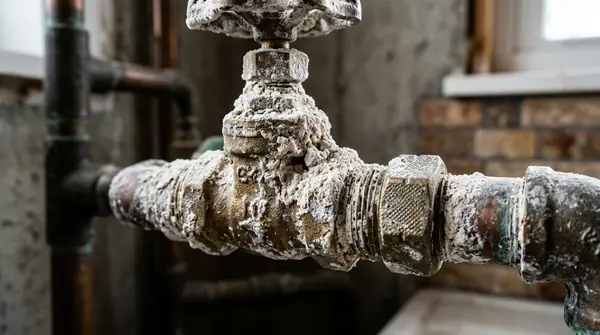
With local water hardness averaging 10 to 20 grains per gallon, calcium and magnesium deposits continuously calcify inside copper and galvanized pipes. Over time, sediment chokes internal pipe diameters and clogs faucet aerator screens, which can be explored through our Salt Lake Hard Water Guide.
3. Corroded Galvanized Iron Pipes
Homes built before 1970 frequently feature galvanized steel water pipes. Galvanized steel rusts internally, creating thick iron tuberculation that reduces 3/4-inch supply pipes to narrow trickle openings, which can be explored through our PEX Repiping Solutions.
4. Hidden Underground or Slab Water Leaks
An undetected pinhole leak under a concrete foundation or inside a wall cavity diverts water volume away from household fixtures, causing unexplained pressure drops and rising utility bills, which can be explored through our Acoustic Slab Leak Detection.
5. Partially Closed Main Shutoff Valve
If recent plumbing work was performed, your main water shutoff valve near the water meter or basement wall may not have been opened completely.
How to Restore Proper Water Pressure in Your Home
Take these practical troubleshooting steps before calling a professional plumber:
- Clean Faucet Aerators: Unscrew mesh aerators from affected spigots and soak in white vinegar to dissolve calcium crust.
- Check Water Meter & Shutoff Valve: Ensure your main indoor shutoff valve handle is turned fully parallel to the supply pipe.
- Test Municipal Supply Pressure: Attach a pressure gauge to an outdoor hose bib. Standard residential pressure should range between 45 and 70 PSI.
- Schedule Professional Pipe Inspection: If pressure remains low across all fixtures, call Salt Lake Plumbers at (385) 488-0770 to evaluate PRV performance or perform repiping.
Frequently Asked Questions
What causes low water pressure in a single fixture?
Low water pressure restricted to a single faucet or showerhead is usually caused by mineral scale clogging the fixture aerator mesh or a malfunctioning internal valve cartridge.
How does a failing pressure reducing valve (PRV) affect water pressure?
A failing pressure reducing valve can lock in a partially closed position, causing a sudden loss of water pressure across all household fixtures when multiple taps are opened.
Can corroded galvanized pipes cause low water pressure?
Yes, older galvanized iron pipes accumulate internal mineral rust and scale over decades, drastically narrowing internal pipe diameter and restricting total water volume to household fixtures.
Experiencing Low Water Pressure in Salt Lake City?
Call Salt Lake Plumbers at (385) 488-0770 to schedule a PRV test, leak inspection, or repiping consultation.
Call 24/7: (385) 488-0770